
If your business cannot survive a fortnight without your direct intervention, you don’t own a scalable asset; you own a high-stress job that happens to have your name on the door. It’s a common trap for UK founders who find themselves caught in a cycle of micromanagement and inconsistent service delivery. You know you need to streamline business operations UK to protect your margins, especially as the National Living Wage rises to £12.71 per hour and new MTD requirements for 2026 demand tighter digital record-keeping.
You likely feel that the only way to maintain quality is to be involved in every decision, yet this owner-dependency is exactly what’s causing your profit leakage. This guide outlines a pragmatic path to move from owner-led chaos to repeatable, system-driven efficiency in just 12 weeks. We’ll explore how to audit your current workflows, eliminate bottlenecks, and build a self-sustaining operation where team accountability is the default rather than the exception. It’s time to replace personality-driven effort with the structural integrity your business deserves.
Key Takeaways
- Identify the hidden costs of operational friction and why “stalling growth” is often a symptom of internal chaos rather than a lack of market demand.
- Discover the clinical steps required to streamline business operations UK by transitioning from personality-driven tasks to repeatable, system-led workflows.
- Understand why professional process mapping is the essential foundation for establishing team accountability and ensuring consistent service delivery.
- Avoid the “tech trap” by ensuring your systems and ERP alignment are built around proven processes rather than using software to automate existing dysfunction.
- Follow a structured 12-week roadmap designed to deliver immediate “quick wins” and long-term operational stability for your organisation.
The Hidden Cost of Chaos: Why UK Service Businesses Struggle to Streamline
Operational streamlining isn’t a vague corporate buzzword. It’s the clinical removal of friction from your service delivery. For many UK service firms, growth doesn’t stop because of a lack of customers; it stops because the internal machinery has seized up. You might see high market demand and a full diary, yet your net profit remains stagnant. This is the “stalling growth” trap. It happens when a business relies on the manual, personality-driven efforts of a few key individuals rather than repeatable systems. To streamline business operations UK effectively, you must identify these symptoms before they become terminal.
In this environment, “busy-ness” is frequently confused with productivity. Your team is working late, the office feels frantic, and you’re personally involved in every minor escalation. This isn’t a sign of a thriving company; it’s a sign of an operational ceiling. You’ve reached the limit of what manual effort can achieve. Manual, personality-driven efforts eventually fail as the team grows; the lack of standardisation leads to inconsistent quality and client dissatisfaction. To break through, you need to adopt a structured approach to Business Process Management. This ensures that every action taken by your team adds measurable value to the client journey rather than just filling time.
The transition from an owner-led business to a system-led organisation is often uncomfortable. It requires a shift in mindset from doing the work to designing how the work is done. Without this shift, you remain the primary bottleneck. Every decision must pass through you, which slows down service delivery and frustrates your most capable staff. By removing yourself as the central cog, you allow the business to function with a level of precision that manual effort simply cannot match.
Diagnosing the Operational Bottleneck
Identifying where a process is stalling requires a clinical perspective. Most UK directors are too close to the daily operations to see the hidden fractures. They’ve grown used to the workarounds and the “way we’ve always done it.” A workflow audit reveals these bottlenecks by mapping the project path from lead to delivery. When you see where decisions stall, you understand why morale is dipping. Profit leakage is usually a thousand small fractures in your process that drain your resources.
The Goal: Self-Sustaining Operations
The objective when you streamline business operations UK is not temporary excitement or a short-lived burst of efficiency. It’s long-term structural integrity. A repeatable system ensures a task is performed to the same high standard regardless of who handles it. This level of clarity does more than reduce stress; it increases business valuation. If you plan an exit, a buyer isn’t looking for your personal brilliance. They want a self-sustaining operation that generates predictable profit without your constant intervention.
Transitioning from Owner-Led Chaos to System-Led Stability
Many UK business owners are trapped in the “firefighter” role. They mistake being essential for being successful. If you are the only person who can solve a technical crisis or approve a minor invoice, you aren’t a CEO; you’re a bottleneck. This presence creates a ceiling on your ability to streamline business operations UK because the organisation’s speed is limited by your personal bandwidth. You become the single point of failure. When you are constantly “fighting fires,” you lose the capacity to design the systems that prevent those fires from starting in the first place.
Owner-dependency manifests in specific, destructive ways. Decisions stall because the team is waiting for your input. Staff hesitate to take initiative, fearing they’ll get it wrong without your specific sign-off. Accountability vanishes because “the boss will fix it” becomes the unspoken cultural norm. Transitioning away from this chaos requires a clinical approach to documentation. You must extract the knowledge from your head and codify it into repeatable processes that others can execute with precision. This isn’t about micro-management; it’s about building the scaffolding that allows your business to function with independence.
Reducing Owner Dependency
Stepping back is often the most selfless act a director can perform. It allows your team to grow and your business to scale without your physical presence. To achieve this, many firms benefit from non-executive leadership support UK to provide the external perspective and objective accountability needed to stay on track. By following the UK Government’s guide to continuous improvement, you can ensure your operational changes are aligned with recognised standards of excellence. Empowering your team through clear governance models ensures that authority is distributed, not hoarded.
Building Accountability Frameworks
True efficiency comes from shifting your focus from “checking on people” to “checking the process.” If a mistake occurs, the first question should be “Where did the system fail?” rather than “Who messed up?” This approach organises team behaviour around tangible outcomes and performance metrics rather than hours spent at a desk. An accountability framework is the bridge between strategy and execution that ensures every team member knows exactly what they are responsible for and how their success is measured. If you want to see where your current gaps lie, a professional Diagnostic & Workflow Audit can provide the clarity needed to begin this transition.
The Process Mapping Framework: Designing Repeatable Business Systems
Tracking performance metrics is futile if the underlying workflow is fundamentally broken. To effectively streamline business operations UK, you must first create a clinical map of how value moves through your organisation. This is why professional business process mapping services are the foundation of any restructuring project. Without this visual clarity, you’re merely guessing where the friction lies. You must identify every touchpoint in the client journey, from the initial lead generation to final service delivery, to understand where time and profit are being wasted.
Most service firms suffer from “hidden fractures” where information is lost between departments. Sales might promise a timeline that operations cannot meet, or project managers might lack the data needed to initiate a billing cycle. These points of failure occur when a business relies on individual preferences rather than a unified standard. Success requires standardising the “favourite” way of doing things into the “only” way. As noted in the Forbes guide on Succeeding with Process Automation, initiatives often fail because the manual process wasn’t clarified before the technology was introduced. You cannot automate a mess.
The 4-Step Diagnostic Process
- Step 1: Clinical Diagnosis. Conduct a thorough audit of current inefficiencies and identify exactly where the bottlenecks occur.
- Step 2: System Architecture. Design a repeatable framework that ensures every task follows a logical, efficient sequence.
- Step 3: Implementation Support. Align the team with the new processes through hands-on training and clear communication.
- Step 4: Sustainability Frameworks. Establish the governance needed to ensure the new systems remain in place long after the initial project ends.
Standard Operating Procedures (SOPs)
SOPs are not meant to be dusty manuals that sit on a shelf; they are the living operational manual for your business. They ensure team consistency across even the most complex service delivery workflows. When you integrate high-quality process design with Performance Optimization, you create a culture where excellence is a repeatable outcome rather than a happy accident. This level of detail is essential to streamline business operations UK and protect your margins against rising labour costs. By making your processes visible and documented, you provide the scaffolding your team needs to perform at their peak without your constant supervision.
The Tech Trap: Why Software Alone Won’t Streamline Your Business
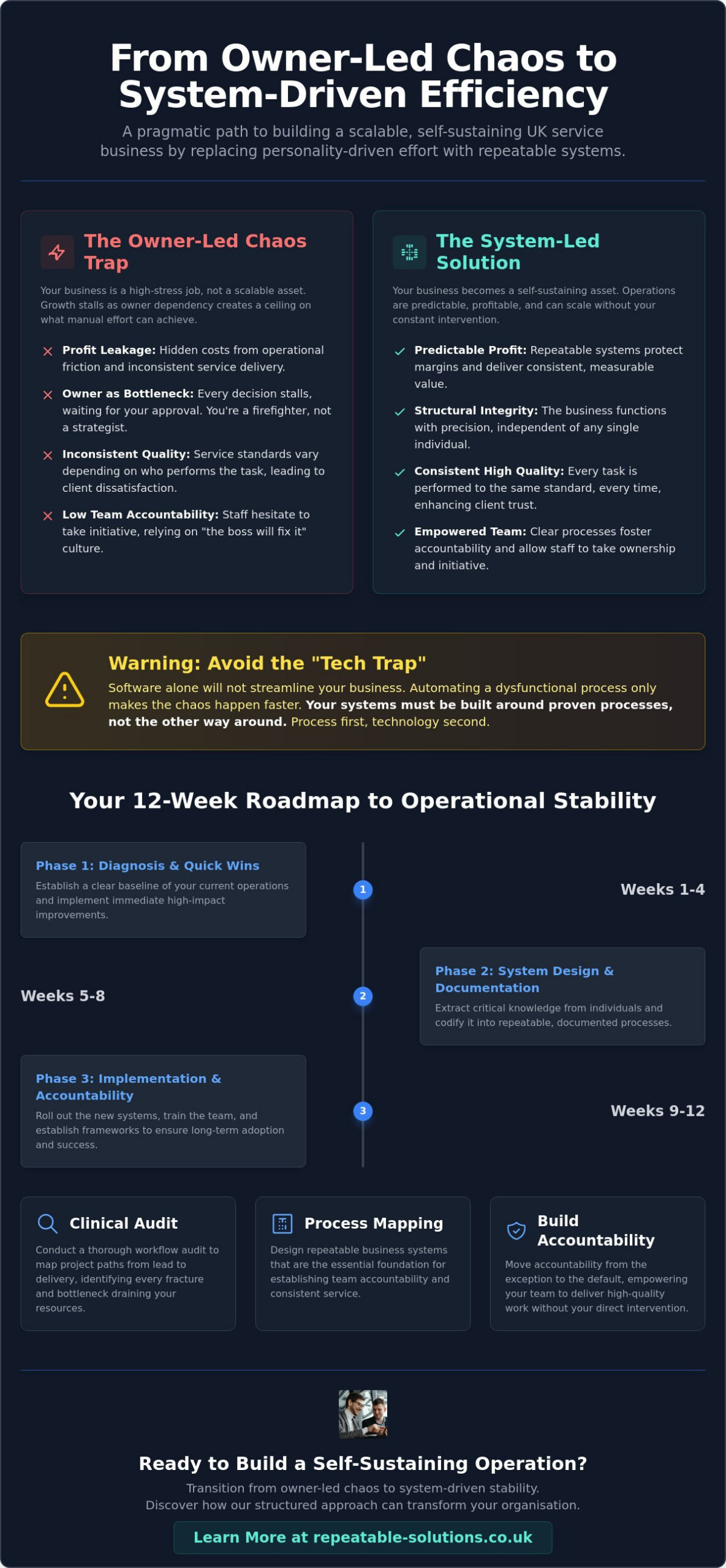
Technology is a force multiplier, not a solution in itself. If your underlying business process is flawed, adding a high-cost automation tool simply ensures those flaws occur at a higher frequency and scale. This is the “Chaos in, Chaos out” rule. Many directors attempt to streamline business operations UK by purchasing expensive software subscriptions before they’ve defined their manual workflows. This approach is a mistake. It leads to “shiny object syndrome,” where the business becomes a collection of disconnected tools that increase operational friction rather than reducing it.
Pragmatic technology must execute your strategy, not define it. Your systems and ERP should be clinical reflections of your proven processes. When the software dictates how you work, you lose the competitive advantage of your unique service delivery model. You end up paying for features you don’t need whilst struggling with a tech stack that feels cumbersome and restrictive. To avoid this, you must align your digital tools with the structural integrity of your organisation. If you are unsure where your current technical bottlenecks lie, a professional Systems & ERP Alignment review can identify where your tech is failing to support your growth.
Fixing the Workflow Before the Tech
A business systems audit is the first step toward digital efficiency. You must see what is actually being used by your team versus what is merely being paid for every month. Manual clarity must always precede digital automation. You need to know exactly how a task is completed on paper before you ask an algorithm to handle it. Simplifying your tech stack often involves removing redundant platforms and focusing on a few core tools that integrate seamlessly. This reduction in complexity lowers the cognitive load on your team and ensures that your digital environment remains stable and predictable.
Data-Driven Decision Making
Once your repeatable systems are digitised, data becomes your most valuable diagnostic tool. It allows you to monitor the health of your operations in real time. You should distinguish between “lagging” indicators, such as last month’s profit margins, and “leading” indicators, such as current project turnaround times or team capacity levels. Leading indicators allow you to spot a potential bottleneck before it impacts your bottom line. Data should be used to validate process health, not just report on past failures. By using these insights, you can move from reactive firefighting to proactive management, ensuring your business remains on a trajectory of sustained growth.
Implementing Operational Change: A 12-Week Roadmap to Efficiency
Operational restructuring cannot be an open-ended aspiration. It requires a time-bound, project-based approach to prevent initiative fatigue and ensure momentum. To streamline business operations UK, you need a structured 12-week roadmap that moves from identification to adoption with clinical precision. This timeline creates the necessary pressure to stop “thinking” about change and start executing it. Without a defined end date, restructuring efforts often dissolve into the daily noise of the business.
The roadmap follows a logical progression of diagnosis, design, and execution. Each phase builds upon the previous one to ensure the resulting systems are both durable and practical. This methodical pace ensures the organisation isn’t overwhelmed whilst maintaining a steady trajectory toward stability.
- Days 1-30: Diagnosis and “Quick Wins”. The first month is dedicated to a clinical audit of your current workflows. You identify the “Quick Wins”-minor operational adjustments that require minimal effort but deliver immediate relief to your bottom line or team capacity.
- Days 31-60: Redesign and Mapping. Once the fractures are identified, you begin redesigning the core workflow. This phase focuses on detailed process mapping and extracting the owner’s knowledge into repeatable system architecture.
- Days 61-90: Execution and Adoption. The final month is about implementation. You establish the accountability frameworks needed to ensure the team adopts the new standards. Success is measured by the system’s ability to function without your direct intervention.
Overcoming Resistance to Change
Managing the “human element” is often the most challenging aspect of restructuring. Your team may view new systems as a critique of their past performance or a threat to their autonomy. “The way we’ve always done it” is a comfortable but dangerous trap for any growing firm. To streamline business operations UK effectively, you must foster a culture that prizes efficiency and predictability over individual preference. Leadership support is non-negotiable during this period. If the directors don’t adhere to the new governance, the team will quickly revert to chaotic, personality-driven habits.
Your Next Steps for Operational Stability
Achieving long-term structural integrity starts with a strategic operational planning session. It’s difficult to diagnose your own bottlenecks when you’re caught in the middle of them. Often, an external “fixer” is required to provide the objective perspective needed to identify hidden fractures in your service delivery. This external accountability ensures the project stays on track and the new systems are built to last. To begin your transition from owner-led chaos to system-led growth, Book an operational audit with Repeatable Solutions and secure the future of your organisation.
Securing the Structural Integrity of Your Business
Sustainable growth is never the result of accidental effort; it is the product of disciplined systems. You’ve identified that relying on manual, personality-driven work creates an operational ceiling that limits both your freedom and your business valuation. To truly streamline business operations UK, you must move beyond the “firefighter” mindset and implement repeatable frameworks that ensure quality remains consistent as you scale. This transition is not merely a technical upgrade; it’s a fundamental shift toward long-term viability.
Repeatable Solutions brings over 30 years of industry experience to help you navigate this transition. As specialists in service-based company operations, we utilise a structured 4-step diagnostic process to identify hidden bottlenecks and align your team with a high-performance workflow. It’s time to replace chaos with clinical precision. Request an Operational Audit from Repeatable Solutions today to begin building the scaffolding your organisation deserves. Your business should be a self-sustaining asset, and with the right systems in place, it will be.
Frequently Asked Questions
How long does it typically take to streamline business operations in the UK?
A comprehensive restructuring project typically requires 12 weeks to move from initial diagnosis to full team adoption. This time-bound approach allows for the clinical identification of bottlenecks, the redesign of core workflows, and the establishment of accountability frameworks. It ensures the new systems remain durable and self-sustaining rather than being temporary fixes that dissolve once the initial project concludes.
What is the difference between operational strategy and business process mapping?
Operational Strategy defines the high-level objectives and structural goals of your organisation, whilst process mapping is the granular documentation of specific workflows. Strategy determines where the business needs to go to remain competitive. Process mapping provides the clinical blueprint for how every task is executed to get there, ensuring that individual preferences don’t compromise the consistency of your service delivery.
Do I need to buy new software to streamline my business operations?
No, you often don’t need new software; you need better alignment with your existing tools. Automating a broken process only creates faster failure. To streamline business operations UK, the focus should be on manual clarity and Process Design first. You should only use technology to execute a strategy that has already been proven to work manually, reducing unnecessary subscription costs and technical friction.
What are the most common operational bottlenecks in service-based companies?
The most frequent bottlenecks are owner-dependency, inconsistent information handover between departments, and a lack of clear team accountability. These “hidden fractures” lead to significant profit leakage and service delays. In the UK market, where the National Living Wage is rising to £12.71 per hour, these operational inefficiencies become increasingly expensive and can quickly erode your net profit margins if left uncorrected.
How can I reduce my business’s dependency on me as the owner?
You reduce dependency by codifying your knowledge into repeatable systems and empowering your team through clear governance. Moving from owner-led chaos to system-led stability requires you to step back from daily “firefighting”. You must focus on designing the scaffolding that allows the business to function without your constant intervention, which is essential for any director planning a future exit or seeking operational freedom.
Is an operational efficiency consultancy worth the investment for a small business?
Yes, because the cost of “stalling growth” and profit leakage usually far outweighs the investment in professional restructuring. An external expert provides the objective perspective needed to identify bottlenecks that directors are often too close to see. This investment focuses on long-term viability, ensuring a higher business valuation and predictable margins that allow a small business to scale sustainably without constant external intervention.
What is a workflow audit and why do I need one?
A Diagnostic & Workflow Audit is a clinical review of how work moves through your business from lead to delivery. You need one to identify exactly where information is lost and where friction occurs. This audit provides the data-driven evidence required to streamline business operations UK, allowing you to eliminate waste and optimise your team’s performance by replacing manual effort with system-driven results.
How do I ensure my team actually follows the new processes?
You ensure adoption by building accountability frameworks that check the process rather than the person. When team behaviour is organised around tangible outcomes and clear performance metrics, following the system becomes the default path. Leadership must also consistently adhere to the new standards to prevent a return to chaotic habits, ensuring that the new workflows are viewed as permanent structural improvements rather than optional suggestions.