
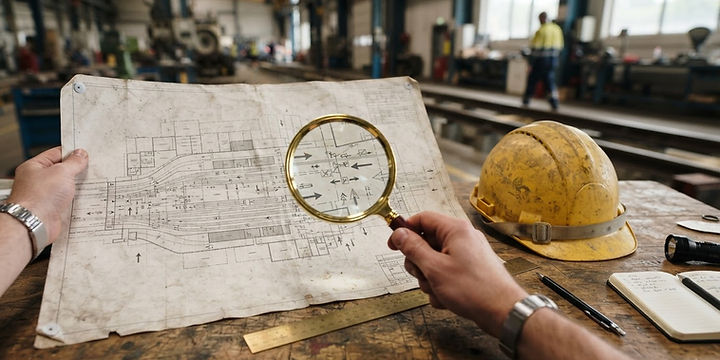
Thirty-five years across equipment hire, car hire and field service operations teaches you that the numbers on a P&L rarely point to the real problem. The real problem is usually standing on the yard: a unit that's shown as "available" for three days but hasn't actually been checked, cleaned or moved. A hire desk re-keying the same job into two systems because nobody trusts the first one. A depot team quietly covering for a process nobody ever wrote down.That's what an operations diagnostic is for - not a report that sits in a drawer, but a structured look at how work actually happens on the ground, so you can see what's costing you money before it shows up as a bad quarter.
What We Mean by an Operations Diagnostic
An operations diagnostic examines the processes, systems, people and assets behind daily performance, and asks the questions that are specific to businesses built around fleet, hire and field work:
• Can you trust the fleet availability figures on the system, or does the yard tell a different story?
• How long does it really take from a unit coming back to it being hire-ready again?
• How much of the hire desk's day goes into admin that never touches a customer?
• Are field engineers waiting on information that should already be with them?
• Where do handovers between depots, desks and engineers break down?
Where Hidden Inefficiency Actually Hides
In most hire, rental and field service operations, the same handful of areas account for most of the lost time and margin:
• Fleet and asset visibility - availability data that doesn't match what's physically on the yard
• Asset turnaround - the gap between a unit coming back and being ready to go out again
• Hire desk process - duplicate data entry, manual quoting, chasing paperwork
• Field-service scheduling - jobs booked without checking engineer location or parts availability
• Depot utilisation - some sites overloaded, others sitting under capacity
How This Builds Up Without Anyone Noticing
It rarely arrives all at once. A business takes on another depot, another contract, another few hundred units, and the processes that worked for a smaller operation quietly start to strain. Nobody decides to run an inefficient hire desk - it happens because growth outpaces the systems supporting it, and the people closest to the work end up absorbing the gap.
How We Actually Run a Diagnostic
This isn't a consultant arriving, writing a report and disappearing. We spend time with the people doing the work - hire desk staff, yard teams, field engineers, depot managers - and run it through short, regular huddles and playbacks: quick sessions where we show the team what we're seeing, check it against what they know from the floor, and agree together what's real and what needs to change.
That matters because a diagnostic only has value if the people who have to live with the findings recognise them as accurate. We'd rather have a shorter list the team believes in than a long one nobody trusts.
What Good Looks Like Once You Have Visibility
Fleet availability figures you can act on. Faster asset turnaround. A hire desk process that doesn't involve typing the same job twice. Field engineers arriving with the right information instead of working it out on site. None of this requires a bigger team - it requires seeing clearly what's actually happening, then fixing it with the people who do the work every day.
FAQs
1. What is the purpose of an operations diagnostic for a hire or rental business?
To identify exactly where fleet visibility, hire desk process, depot utilisation and field scheduling are costing time and money, and to build a practical plan to fix it - not just to describe the problem.
2. How is this different from a general operations review?
It's built around how hire, rental and field service businesses actually work - fleet, depots, hire desks, engineers - rather than generic process theory that could apply to any industry.
3. What areas does the diagnostic cover?
Typically fleet and asset visibility, asset turnaround times, hire desk workload, field-service scheduling and depot utilisation, plus the systems and communication that connect them.
4. Do we need new software to act on the findings?
Not usually. Most of what a diagnostic surfaces is fixed by changing how existing systems and processes are used, not by buying something new.
5. Who needs to be involved from our side?
The people who actually do the work - hire desk staff, depot and yard teams, field engineers - because they know where the process breaks down day to day.
Ready to See What's Really Happening on Your Yard?
Repeatable Solutions works alongside equipment hire, car hire, asset rental, engineering and field service businesses to find what's really costing them, using thirty-five years of yard-to-board operating experience. Contact us to talk through an operations diagnostic for your business.