
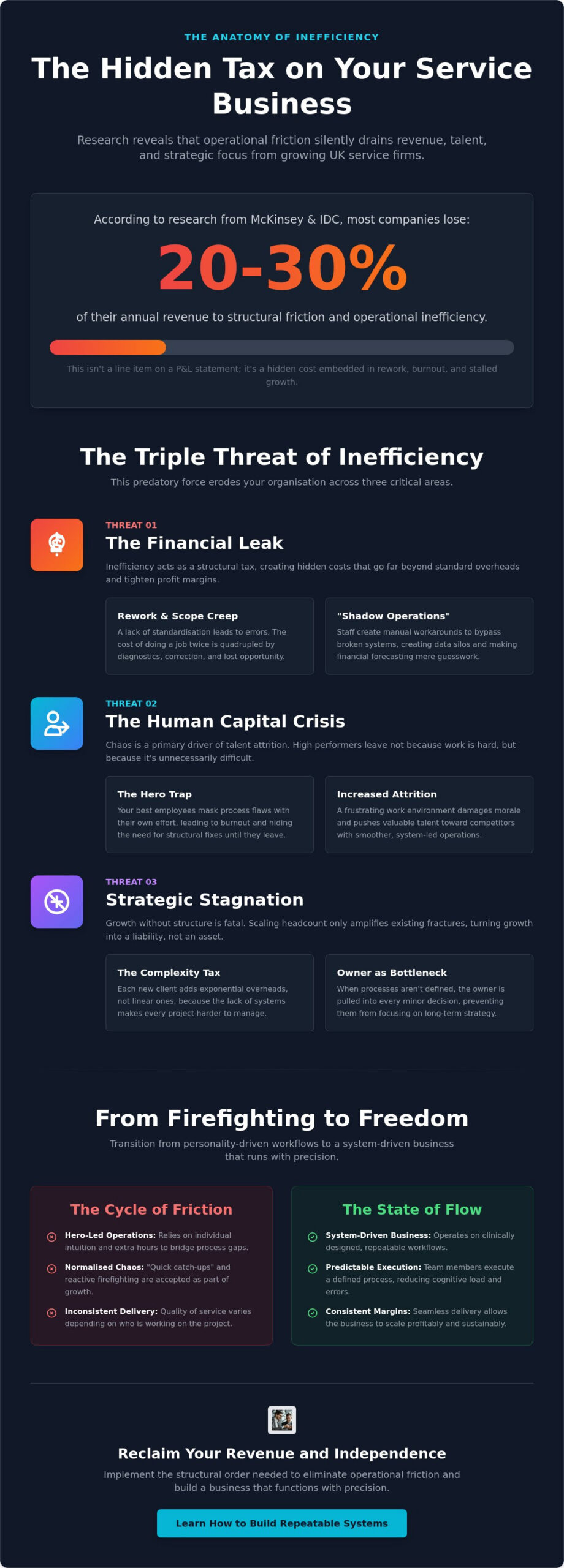
Research from McKinsey and IDC indicates that most companies lose between 20% and 30% of their annual revenue to structural friction. In a service business, this cost of operational inefficiency is rarely a visible line item; instead, it’s felt in the exhaustion of an owner who acts as the primary bottleneck for every decision. You likely recognise the frustration of a business that relies on individual heroics rather than repeatable systems, leading to inconsistent delivery whilst your team burns out trying to manage the chaos. It’s a cycle that turns growth into a liability rather than an asset.
This article provides a pragmatic framework to identify these hidden drains and reclaim your professional independence. You’ll learn how to move away from personality-driven workflows and implement the structural order needed to stabilise your margins. We’ll examine the clinical reality of operational friction and outline the steps required to build a business that functions with precision, allowing you to step back from the daily grind and focus on the long-term viability of your organisation.
Key Takeaways
- Distinguish between “productive busy-ness” and genuine value creation to eliminate the friction stalling your growth.
- Identify the true cost of operational inefficiency, including the financial impact of over-servicing and the human cost of staff turnover.
- Understand why scaling your headcount without structural alignment only serves to amplify existing fractures in your workflow.
- Adopt a clinical approach to auditing your processes to identify bottlenecks without the distortion of team bias.
- Learn the structural steps required to transition from manual, hero-led operations to a system-driven business that runs with precision.
Defining the Invisible Drain: What is Operational Inefficiency?
In many UK service firms, inefficiency isn’t a loud or obvious failure. It doesn’t look like people sitting idle or projects being abandoned. Instead, it often manifests as a frantic, over-capacity office where everyone is working ten-hour days. This is the great deception of “productive busy-ness.” You see constant activity and assume value is being created, but in reality, your team is merely fighting the friction between their intent and the actual execution of tasks. To the untrained eye, this looks like hard work. To a clinical observer, it’s a structural breakdown.
Operational inefficiency is the silent erosion of a company’s structural integrity. It functions like a hidden tax on every action your business takes. Whilst operational efficiency focuses on the optimal ratio of inputs to outputs, inefficiency is the energy lost to heat in the machine. It’s the time spent searching for files, the hours wasted in meetings to clarify previous meetings, and the rework required because the original process was personality-driven rather than system-led.
The Anatomy of Normalised Chaos
Scaling businesses frequently fall into a trap called “Normalised Chaos.” This occurs when the leadership team begins to accept operational friction as an unavoidable part of growth. The signs are subtle but pervasive. You’ll recognise them in the increase of “quick catch-ups” that lack agendas, or redundant email chains where multiple directors are CC’d on minor decisions that should be automated.
- The Complexity Tax: Without a rigid framework, every new client you sign increases the cost of operational inefficiency. Instead of scaling linearly, your overheads grow exponentially because the lack of structure makes each new project harder to manage than the last.
- The Hero Trap: Your most talented employees are often the ones masking the deepest fractures. Because they’re capable, they use their own intuition and extra hours to bridge the gaps in your processes. This hides the need for structural correction until they eventually burn out and leave.
Friction vs. Flow: The Service Delivery Spectrum
True operational health is defined by “Flow.” This is the seamless, predictable movement of a client from the initial lead to the final delivered result. It requires a business to function on systems rather than individual heroics. When your workflows are designed with clinical precision, the cognitive load on your team drops. They no longer have to “figure out” how to do their jobs every morning; they simply execute the process. Reducing the cost of operational inefficiency isn’t about working faster. It’s about removing the structural obstacles that make work harder than it needs to be.
The Triple Threat: Financial, Human, and Strategic Costs
Operational inefficiency is a predatory force. It doesn’t merely sit on your balance sheet as a static figure; it actively erodes your ability to scale. Many UK service firms suffer from “Margin Creep,” a condition where overheads grow at a faster rate than revenue. You might see your turnover increasing and assume growth is healthy, but if your profit margins are tightening, you’re likely paying a heavy cost of operational inefficiency. This friction acts as a structural tax, draining resources across three distinct areas of your organisation.
The Financial Leak: Beyond the Profit and Loss Statement
The most immediate drain is rework. When a process isn’t standardised, errors become inevitable. Research from McKinsey and IDC suggests that companies can lose between 20% and 30% of their annual revenue due to these inefficiencies. Doing a job twice doesn’t just double the cost; it quadruples it when you account for the original labour, the time spent identifying the error, the correction itself, and the lost opportunity to bill a new client during those wasted hours.
Frustrated staff often create “Shadow Operations” to bypass broken systems. These manual workarounds are invisible to leadership but create massive data silos. Without a unified Systems & ERP Alignment, your financial forecasting becomes guesswork. You can’t see the leak because the data is scattered across spreadsheets and personal inboxes rather than a central source of truth.
The Human Capital Crisis: Morale and Attrition
Chaos is a primary driver of talent attrition. High performers don’t leave because the work is hard; they leave because the work is unnecessarily difficult. In the current UK labour market, where 50% of hiring managers expect turnover to increase in 2026, retaining talent is a strategic necessity. Operational friction creates a culture of “learned helplessness” amongst your team. When staff realise that their suggestions for improvement are ignored in favour of “the way we’ve always done it,” they stop trying. They don’t just become less productive; they start looking for an exit.
The CEO Bottleneck: The Ultimate Strategic Cost
The most expensive cost of operational inefficiency is the “Founder Tax.” If you are the primary decision-maker for every minor client delivery or internal query, you are the bottleneck. Every hour you spend firefighting is an hour not spent on high-level Operational Strategy or market expansion. A business that depends on its owner for daily survival is a liability, not an asset. This dependency significantly reduces your valuation at exit. Investors don’t buy jobs; they buy systems. Transitioning from an owner-led model to a system-led framework is the only way to reclaim your time and build a business with genuine market value.
The Busy-ness Trap: Why Growth Without Structure is Fatal
Growth is a magnifier. If your current operations are fractured, scaling your business won’t fix the problem; it will simply make those fractures larger and more expensive to repair. Many business owners respond to increased demand by working harder or hiring faster, treating “busy-ness” as a badge of success. In reality, working harder is a finite resource that inevitably leads to burnout. Without a rigid structural framework, you will eventually hit the “Scalability Wall.” This is the precise point where your service quality drops as volume increases, and the cost of operational inefficiency begins to swallow your remaining margins.
Why More Staff Often Equals Less Efficiency
There is a common misconception that hiring more people solves operational bottlenecks. Usually, the opposite is true. Every new hire introduces “Communication Overhead,” which is the exponential increase in the complexity of information flow. If two people need to coordinate, there is one link. If five people need to coordinate, there are ten links. Without Process Design, these links become points of failure.
Adding headcount to a broken process is like pouring water into a sieve. You might increase your capacity in the short term, but you’re also increasing the volume of waste. To scale sustainably, you must adopt a “Process Before People” strategy. This ensures that your team is stepping into a pre-defined system that governs their behaviour, rather than relying on their own intuition to navigate the chaos. When you hire to solve a process problem, you don’t fix the bottleneck; you just make it more expensive to maintain.
The Tech Fallacy: Why Your CRM Won’t Save You
Software is a tool, not a strategy. Many firms attempt to buy their way out of inefficiency by investing in expensive CRM or ERP systems, only to find that the technology adds more friction than it removes. “Off-the-shelf” bloat occurs when you try to force a unique business workflow into a rigid software template. If your underlying processes are flawed, the software simply helps you perform those flawed processes faster. A 2023 report by Boston Consulting Group indicates that 70% of digital transformations fail to achieve their objectives due to poor underlying processes rather than technical issues. Before you look for a technical solution, you must first address the cost of operational inefficiency through a rigorous Diagnostic & Workflow Audit. Only once the logic of the process is sound should you consider the tools to automate it.
Diagnosing the Fracture: How to Audit Your Own Operations
Subjectivity is the enemy of efficiency. When you ask a team member why a project is delayed, you’ll often receive a list of external excuses: a slow client, a technical glitch, or a lack of time. These are symptoms, not causes. To truly understand the cost of operational inefficiency, you must move beyond anecdotal feedback and adopt a clinical, data-driven diagnostic approach. You need an X-ray of your business, not just a pulse check.
A rigorous audit requires you to map the “As-Is” process against the “Should-Be” process. The “As-Is” is the unvarnished reality of how work happens on a Tuesday morning when the pressure is high and the owner is out of the office. The “Should-Be” is the structural ideal. The friction found in the gap between these two states is where your profit is being incinerated. Identifying these fractures is the first step toward Performance Optimization and long-term stability.
Mapping the Service Delivery Journey
Every service business has a lifecycle that begins with a lead and ends with a delivered result. To find the leaks, you must identify every single touchpoint in this journey. Look specifically for “hand-off” points where information moves from one department or individual to another. These are the primary sites of failure where context is lost and delays are born.
Apply the “Three-Day Rule” to your mapping. If a task that requires thirty minutes of actual labour takes three days to move an inch through your pipeline, you have a structural blockage. Is it awaiting an approval? Is the data stuck in a silo? By using Diagnostic & Workflow Audit techniques, you can pinpoint these stagnations with precision rather than guesswork.
Spotting the “Single Points of Failure”
The most dangerous element in any service business is “tribal knowledge.” This is critical operational information that exists only in the heads of specific employees rather than in documented systems. If a key staff member’s absence causes a department to stall, you have a single point of failure. This personality-driven delivery is a massive risk to your structural integrity.
To identify these risks, monitor your weekly leadership meetings for the following red flags:
- Decisions that are consistently deferred because one specific person isn’t present.
- Workflows that require “workarounds” that only senior staff understand.
- Client delivery that varies in quality depending on which team member is assigned to the account.
- A persistent reliance on manual intervention to correct recurring data errors.
Once these fractures are identified, the objective shifts from observation to correction. You cannot scale a business built on the fragile foundation of individual heroics. You must replace tribal knowledge with repeatable systems that ensure consistency regardless of who is performing the task. If you are ready to stop the internal friction and reclaim your margins, it is time to book a professional Diagnostic & Workflow Audit to identify exactly where your business is stalling.
From Firefighting to Freedom: Building Repeatable Systems
Identifying the problem is only the first step. To eliminate the cost of operational inefficiency, you must move from passive observation to active restructuring. This requires a clinical transition from manual, personality-driven intervention to automated, repeatable results. A business that relies on its owner to solve every crisis is a business in a state of permanent fragility. True freedom is found in the scaffolding of systems that govern themselves, allowing you to focus on high-level Operational Strategy rather than daily survival.
The goal is to reach an “Exit-Ready” state. This does not necessarily mean you intend to sell your business tomorrow. It means your business is valuable enough that you could. When a company functions independently of its founder, it becomes a durable asset rather than a demanding job. Reaching this stage requires a methodical approach to change, replacing the friction of chaos with the precision of order.
The 12-Week Transformation Journey
We approach this transformation through a structured 12-week framework designed to stabilise your operations and prepare your organisation for sustainable growth. This isn’t a quick fix; it’s a structural realignment.
- Phase 1: The Diagnostic & Workflow Audit (Weeks 1-3). We conduct a clinical examination of your current state to identify exactly where time and profit are being leaked. We map the “As-Is” processes to uncover hidden bottlenecks.
- Phase 2: Process Redesign and Performance Optimisation (Weeks 4-8). We strip away redundant tasks and design new, streamlined workflows. This phase focuses on Process Design that reduces cognitive load and ensures consistency.
- Phase 3: Implementation Support and Accountability (Weeks 9-12). We provide the necessary scaffolding to ensure the new systems are adopted. This phase is about Execution & Accountability, turning new processes into permanent habits.
Creating a Self-Sustaining Growth Engine
New processes only hold value if they are actually followed. This requires a robust framework where the team takes full ownership of the systems. It isn’t enough to simply document a process; you must build the leadership infrastructure to maintain it. Providing Non Executive & Leadership Support acts as a stabilising force, ensuring that the organisation does not regress into old habits of normalised chaos. When the team is aligned with the system, the cost of operational inefficiency is replaced by predictable profit margins and a business that runs with precision.
Ready to stop firefighting? Book your Operational Health Check with Repeatable Solutions.
Securing Your Business Through Structural Order
Growth is not a remedy for chaos; it’s a catalyst for it. If your service business relies on your personal intervention to function, you aren’t scaling an asset. You’re merely managing a larger liability. Reclaiming your time and profitability requires a clinical shift from manual firefighting to repeatable, system-led execution. By addressing the true cost of operational inefficiency today, you ensure that your organisation remains durable and exit-ready for the future.
Repeatable Solutions brings over 30 years of experience in operational restructuring to help you build a self-sustaining growth engine. Our proven 12-week framework moves your business from initial diagnosis to long-term sustainability, creating systems that run with precision even when you aren’t in the room. This structural order is the only path to predictable margins and professional independence. You’ve built the foundation; now it’s time to build the machine that sustains it.
Book your clinical operational diagnostic with Repeatable Solutions and begin the transition toward a business that functions by design, not by heroics.
Frequently Asked Questions
What are the first signs of operational inefficiency in a service business?
The first signs are typically found in the owner’s calendar and the team’s internal communication patterns. If you are the primary decision-maker for minor delivery tasks, or if your staff relies on constant “quick catch-ups” to clarify instructions, your structure is failing. These symptoms indicate that your organisation relies on individual heroics rather than repeatable systems to function.
How much does operational inefficiency typically cost a UK SME?
Research from McKinsey and IDC indicates that companies lose between 20% and 30% of their annual revenue to structural friction. This cost of operational inefficiency is rarely a visible line item; instead, it’s embedded in rework, over-servicing, and missed billing opportunities. For a scaling firm, these losses compound as the complexity of the business increases.
Can software alone fix my business’s operational problems?
No, software is an accelerator of existing processes, not a substitute for process design. Investing in a CRM or ERP without first fixing the underlying workflow often amplifies existing chaos. Data from Boston Consulting Group shows that 70% of digital transformations fail because firms attempt to automate broken or non-existent processes rather than addressing structural logic.
How long does it take to restructure business operations for efficiency?
A comprehensive operational restructuring typically requires 12 weeks to move from initial diagnosis to long-term sustainability. This timeframe allows for a rigorous audit of current workflows, the redesign of core processes, and a dedicated implementation phase. This methodical approach ensures that new systems are fully integrated into the team’s daily behaviour.
What is the difference between a workflow audit and a standard business audit?
A standard business audit focuses on financial compliance and historical accuracy, whilst a workflow audit examines the clinical logic of your daily operations. The objective of a workflow audit is to identify the friction between intent and execution. It uncovers “single points of failure” and information silos that a financial audit would typically overlook.
Why is owner-dependency considered an operational risk?
Owner-dependency turns the founder into the ultimate bottleneck for every decision, which limits the business’s ability to scale. If an organisation cannot function without your constant intervention, it is a liability rather than a durable asset. This dependency creates a “Founder Tax” that significantly reduces the company’s valuation when you eventually seek an exit.
How do I get my team to adopt new processes without resistance?
Adoption requires a clear accountability framework and consistent leadership support. Teams resist change when it feels arbitrary or adds to their cognitive load. By demonstrating how new systems reduce daily friction and involving staff in the implementation phase, you shift the culture from personality-driven effort to system-driven results.
Is operational restructuring worth it if we are already profitable?
Profitability can often mask deep structural fractures that will eventually lead to a “Scalability Wall.” Even profitable firms suffer from “Margin Creep,” where overheads grow faster than revenue. Addressing the cost of operational inefficiency now protects your future margins and ensures your business remains durable as market conditions or labour costs change.