
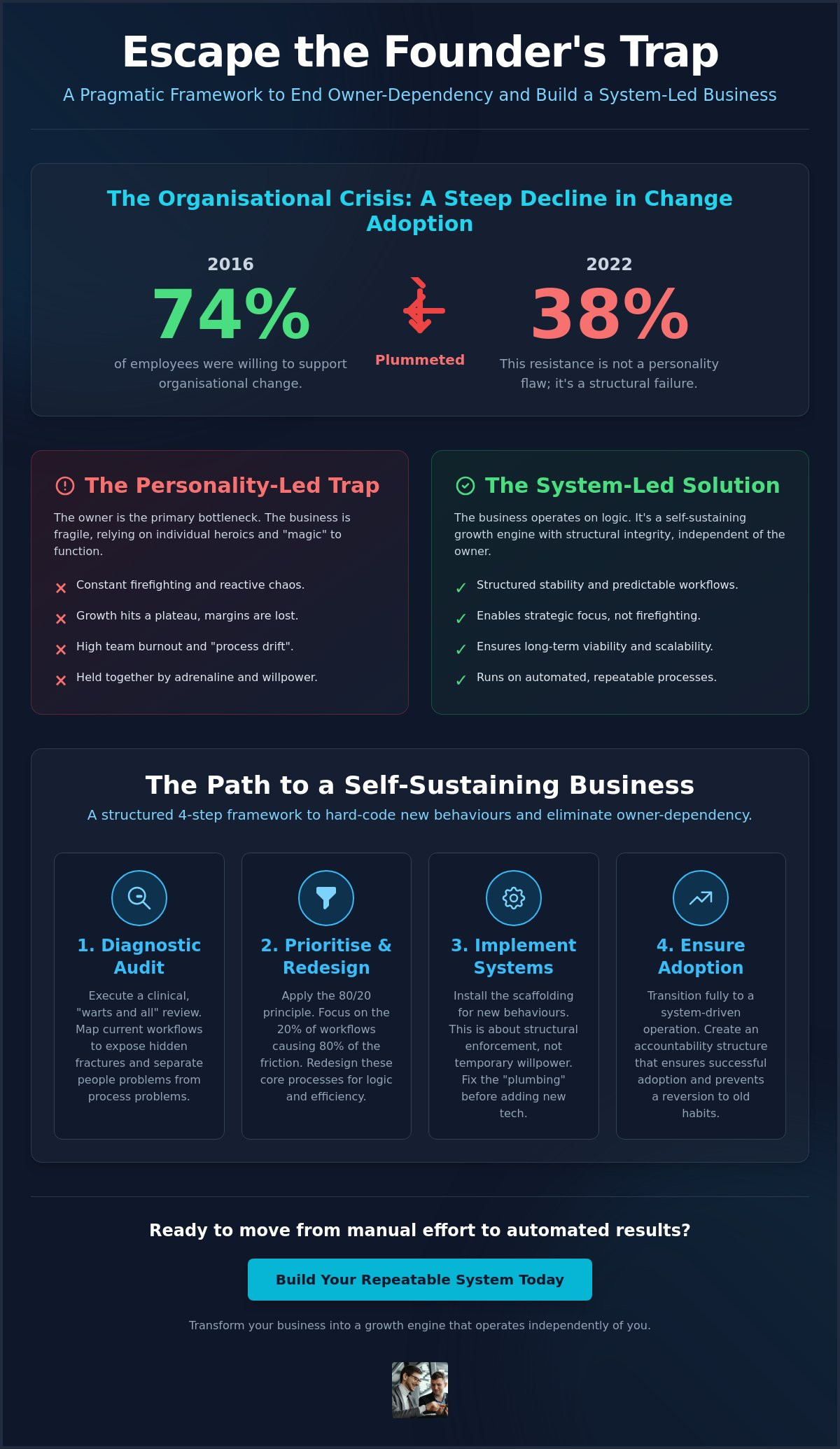
In 2016, 74% of employees were willing to support organisational change; by 2022, that figure plummeted to just 38%. This resistance isn’t a personality flaw in your team. It’s a structural failure. You’ve likely felt the friction yourself as every new process becomes a battle and service delivery hits constant bottlenecks. It’s exhausting to be the only person capable of making a decision whilst your business feels like it’s held together by sheer force of will. Implementing effective change management for small business isn’t about motivational speeches or charm. It’s about hard-coding new behaviours into a repeatable system that functions without your constant intervention.
You deserve a business that runs on logic rather than adrenaline. This guide provides a pragmatic, operational framework for 2026 to help you eliminate owner-dependency and turn operational chaos into structured stability. We’ll examine how to audit your current workflows and implement an accountability structure that allows you to focus on strategy rather than firefighting. It’s time to move from manual, personality-driven effort to automated, system-driven results that ensure long-term viability.
Key Takeaways
- Identify why the “Founder’s Trap” causes organisational change to stall and how to remove yourself as the primary operational bottleneck.
- Execute a clinical diagnostic audit to map your workflows and expose the hidden fractures in your service delivery.
- Move beyond academic models to implement change management for small business through pragmatic, hard-coded systems rather than temporary willpower.
- Apply a structured 4-step framework to redesign your processes and ensure the successful adoption of new, repeatable workflows amongst your team.
- Transition from a personality-driven firm to a self-sustaining growth engine that maintains structural integrity whilst operating independently of its owners.
Why Change Management for Small Business Often Stalls
Small businesses often treat change as a temporary event rather than a permanent structural realignment. In this context, change management for small business is the structured process of transitioning an organisation from its current, chaotic state to a more efficient, system-led operation. Whilst many academic resources outline the foundational principles of change management for large corporations, these models usually ignore the “Founder’s Trap”. This is the specific failure point where the owner remains the primary bottleneck for every operational decision. If you are still the only person who can approve a £500 invoice or resolve a client dispute, your business is personality-dependent, not system-led.
The cost of this dependency is high. It results in lost margins, team burnout, and growth that has reached a plateau. By 2026, the necessity for this shift has become urgent. High demand no longer compensates for poor efficiency. You must move away from manual, personality-driven effort and toward automated, repeatable processes that function independently of your daily input.
The Symptoms of Change Resistance
Resistance isn’t always vocal. It often appears as “process drift”, where teams quietly revert to old, inefficient habits because the new system lacks structural enforcement. For tight-knit service teams, the emotional toll of uncertainty is significant. When processes are vague, staff default to “firefighting” behaviour. They focus on surviving the next hour rather than following a long-term workflow. This lack of clarity breeds a culture of reactive chaos that prevents any meaningful progress.
Moving from Personality-Led to System-Led
Individual heroics are the enemy of scale. If your service delivery relies on a specific staff member performing “magic” to get results, your business is fragile. Successful change requires a clinical diagnostic view of your current operational fractures. You need a “fixer” mindset rather than a traditional “manager” mindset. This means identifying exactly where the process breaks and installing the necessary scaffolding to ensure the business functions with consistency. It’s about creating a growth engine that relies on logic and systems rather than adrenaline and willpower.
The Operational Audit: Diagnosing the Need for Change
Precision is the antidote to operational chaos. You cannot repair a fracture you haven’t located, yet many owners attempt to implement new workflows based on gut feeling rather than data. This is why most initiatives involving change management in the small business context fail before they begin. They treat the symptoms, such as a missed deadline or a frustrated client, without ever diagnosing the underlying process failure. A clinical audit separates people problems from process problems. Often, what looks like a lazy employee is actually a capable person trapped in a broken system. By identifying the “critical path” of your service delivery, you can protect the core functions of your business whilst stripping away the inefficiencies that drain your margin.
Mapping the Current Chaos
A “warts and all” review is uncomfortable but necessary. You must document exactly how work moves through your office, from the first enquiry to the final invoice. This process exposes where data is lost, where tasks are duplicated, and where the owner is forced to intervene. A workflow audit is the clinical mapping of every touchpoint in a service journey. Without this map, any attempt at restructuring is just guesswork. If you need clarity on your existing fractures, a professional Diagnostic & Workflow Audit provides the objective data required to move forward.
Prioritising Operational Restructuring
Not all processes are created equal. Use the 80/20 principle to identify the 20% of workflows causing 80% of your daily friction. Focus your energy there first. This alignment ensures that your change initiatives support long-term capacity planning rather than just providing a temporary fix. You must fix the “plumbing”, the fundamental logic of how you work, before layering on expensive new technology or AI. Software won’t fix a broken process; it will only accelerate the chaos. Effective change management for small business requires the discipline to stabilise the foundation before you attempt to scale the structure.
Generic Change Models vs. Repeatable Systems
Academic models like Kotter’s 8-Step process or the McKinsey 7-S framework were designed for corporate giants with deep pockets and layers of middle management. For a 20-person service firm in the UK, these frameworks are often too cumbersome and slow. They focus heavily on psychological shifts whilst ignoring the hard reality of daily operations. You don’t need a three-month internal PR campaign to change how you process a client enquiry. You need a system that makes the old, inefficient way impossible to continue. Effective change management for small business prioritises structural integrity over temporary excitement. It replaces the need for constant “vision casting” with repeatable systems that function without your intervention. The goal is a business that relies on logic rather than the owner’s charisma to maintain its course.
The Failure of “Soft” Change Management
Town hall meetings rarely fix broken CRM data entries. Whilst change management best practices often highlight the importance of communication, over-communicating a “vision” whilst under-delivering on process only breeds cynicism amongst your staff. Your team doesn’t need more inspiration. They need clarity. They need to know that the new workflow actually works and that it won’t be abandoned the moment a client calls with an “emergency”. Grounded, logical assurance comes from showing staff a more stable way to work, not from asking for their emotional buy-in. When a process is clearly superior and easier to follow, resistance evaporates because the logic is undeniable.
Hard-Coding Change into the Business
Successful change is hard-coded into the business through accountability frameworks. If a new process is optional, it isn’t a process; it’s a suggestion. You must move from manual oversight to system-driven results where the “plumbing” of the business enforces the rules. This is where Non-Executive support becomes vital. An external perspective provides the necessary pressure to maintain momentum when the owner is tempted to revert to old, comfortable habits. By establishing these guardrails, you ensure that structural changes survive the initial implementation phase and become the new operational standard. You aren’t just changing a habit. You’re installing a new operating system that ensures long-term sustainability and independence.
A 4-Step Framework for Small Business Change
Success in restructuring a business requires more than just a list of goals. It demands a proactive implementation strategy that addresses the structural fractures identified in your initial audit. Effective change management for small business follows a methodical, four-step progression to ensure that new systems are not just designed, but actually adopted by the team. This framework moves the organisation from a state of personality-driven chaos to one of system-led stability. It replaces the reactive firefighting common in SMEs with a logical, phased approach to growth.
Step 1 & 2: The Design Phase
The design phase begins with a clinical Diagnosis & Workflow Audit to map every operational touchpoint. Once the fractures are exposed, you move to Process Redesign. This involves aligning your ERP and internal systems with the new workflow to ensure technical feasibility. You must design a process that runs without the owner’s constant input, turning manual effort into a repeatable growth engine. Process design must prioritise simplicity over complexity to ensure team adoption. If a system is too difficult to navigate, your staff will quietly revert to their old, inefficient habits. The goal is to make the new workflow the path of least resistance for everyone involved.
Step 3 & 4: The Execution Phase
Execution is where most initiatives fail because they lack structural enforcement. You must embed the change into daily behaviour through Implementation & Accountability. This involves setting up accountability loops that track adherence to the new process without resorting to micromanagement. These loops provide the grounded, logical assurance your team needs to trust the new system. Success is measured through operational stability and improved team utilisation rates rather than temporary excitement. The final stage, Performance Optimisation, involves tuning the system for long-term sustainability. The ultimate objective is a self-sustaining operation that requires no external assistance after 12 weeks of implementation. By this stage, the business should function as a repeatable system that scales independently of its founders.
If your current workflows are causing service delivery bottlenecks, our Execution & Accountability support provides the necessary scaffolding to ensure these changes actually stick. We help you move from manual oversight to a system-driven result that protects your margin and your time.
Building a Self-Sustaining Growth Engine
The ultimate goal of any change management for small business initiative is the creation of an organisation that functions independently of its founders. If your presence is still required to maintain the daily rhythm of service delivery, you don’t have a system; you have a high-stress job. Transitioning from “firefighter” to CEO requires a fundamental shift in focus from manual intervention to structured operational strategy. This isn’t a vague, long-term aspiration. Meaningful operational restructuring usually occurs within a 4 to 12-week window. During this period, the business moves from reactive chaos to a state of predictable, repeatable performance. It is a sprint to stability that rewards those who prioritise logic over tradition.
The Role of External Accountability
Owners are often too close to the daily chaos to identify the root causes of failure. An objective “fixer” sees the fractures that you have become accustomed to ignoring. This is why project-based consultancy is vital for rapid operational correction; it provides the external pressure needed to ensure new systems aren’t abandoned when things get busy. Repeatable Solutions designs systems that last by focusing on structural integrity rather than temporary motivation. We help service companies fix operational inefficiencies by installing the scaffolding required for a business to scale without increasing the owner’s workload. This external accountability ensures that the transition to a system-led operation is permanent rather than a fleeting experiment.
Next Steps for Your Business
Transformation begins with a clear-eyed assessment of your current state. You must conduct an initial operational health check to identify where your service delivery is most vulnerable. Once the fractures are mapped, you can begin preparing your team for a transition to system-led growth. This involves moving away from individual heroics and toward a culture of consistency. You must communicate the shift not as a burden, but as a stabilisation of their working environment. Removing the “chaos” factor from their daily routine is the most effective way to secure buy-in. If you are ready to eliminate the bottlenecks that prevent your business from running autonomously, contacting a specialist to diagnose your specific service delivery fractures is the logical first step. It’s time to build a growth engine that relies on logic, not adrenaline.
Securing Your Operational Future
Operational stability is not a byproduct of luck; it’s the result of deliberate system design. Transitioning from a founder-dependent firm to a self-sustaining growth engine requires you to prioritise clinical diagnosis over reactionary fixes. By following a structured framework, you ensure that new workflows are hard-coded into your business rather than relying on the temporary willpower of your team. Effective change management for small business is about building a foundation that remains durable whilst you step away from daily firefighting to focus on high-level strategy.
Success requires an objective perspective and a proven methodology. With over 30 years of industry experience in operational restructuring, Repeatable Solutions provides the scaffolding your business needs to scale. Our proven 4-step framework focuses on creating self-sustaining operations that run without ongoing consultancy. You don’t need a permanent advisor; you need a system that works. Take the first step toward clinical precision and Book an Operational Diagnostic with Repeatable Solutions today. It’s time to build a business that functions with consistency, predictability, and independence.
Frequently Asked Questions
What is the most common reason change management fails in small businesses?
The “Founder’s Trap” is the primary failure point. Change fails when the owner remains the central decision-maker for every operational task. Without removing this owner-dependency, new processes are eventually bypassed by staff who default to asking the owner for a quick fix. This reverts the business to its previous chaotic state because the system was never truly independent.
How long does it typically take to implement a new operational system?
Meaningful operational restructuring usually requires a 4 to 12-week window. This timeframe allows for a clinical audit, process redesign, and the establishment of accountability loops to ensure the team adopts the new workflow. Attempting to rush this process leads to superficial changes that don’t survive the first high-pressure situation the business encounters.
Do I need expensive software to manage change in my SME?
No, software is a secondary consideration to process design. You must fix your operational “plumbing” before layering on new technology. Effective change management for small business relies on logical, repeatable workflows rather than high-cost digital tools. Software won’t fix a broken process; it will only accelerate the chaos already present in your firm.
How can I get my team to stop reverting to their old ways of working?
Install structural guardrails that make the old way impossible or significantly harder to follow. Reversion happens when new processes are treated as suggestions rather than requirements. By hard-coding new behaviours into your systems and using regular performance optimisation checks, you ensure the new workflow becomes the path of least resistance for every team member.
Is change management different for service-based companies versus retail?
Yes, the focus shifts from physical assets to intellectual workflows. Service companies must manage the “invisible” movement of data and deliverables amongst team members. Whilst retail focuses on inventory and logistics, service firms require change management for small business that prioritises the clinical mapping of client touchpoints and the elimination of service delivery bottlenecks.
When should a small business owner consider hiring an operations consultant?
You should seek external support when your business has reached a growth plateau or when you are the primary bottleneck. If every decision requires your input and service delivery is hit by frequent bottlenecks, an objective “fixer” can identify the fractures you’ve become accustomed to ignoring. This provides the necessary scaffolding for your eventual independence.
How do I balance daily firefighting with the need for long-term change?
Use the 80/20 principle to identify the 20% of processes causing 80% of your daily friction. By fixing these high-impact fractures first, you create the operational capacity needed for broader restructuring. You cannot fight every fire at once. You must prioritise the structural repairs that prevent future outbreaks whilst maintaining your current service standards.
What are the first steps in a business process mapping project?
Begin with a clinical mapping of every touchpoint in your current service journey. Document exactly how work moves from the initial enquiry to the final invoice, identifying where data is lost or tasks are duplicated. This “warts and all” review provides the objective data required to design a repeatable system that functions without your constant managerial intervention.