
If your business grinds to a halt the moment you step away, you don’t own a company; you own a high-stress job that’s masquerading as an asset. It’s a common trap for UK founders who’ve scaled on pure adrenaline but now find themselves trapped by owner-dependency and inconsistent service delivery. Finding a reliable operational efficiency consultancy UK is the logical next step, yet the market is often saturated with theorists who offer advice without accountability. You need more than a slide deck; you need a structural overhaul that transforms manual chaos into a system-driven engine.
You’re likely tired of seeing profit margins eroded by wasted effort whilst facing the 2026/27 corporation tax rates and rising non-commodity energy charges. We agree that a business should be a predictable machine, not a source of constant fire-fighting. This guide will show you how to identify and select a partner capable of delivering repeatable, documented systems and clear performance metrics. We’ll explore the essential diagnostic steps, the necessity of implementation support, and how to ensure your chosen consultancy builds a scalable infrastructure that functions without your constant intervention.
Key Takeaways
- Learn why owner-dependency is a structural failure that cannot be solved by simply working harder or hiring more staff.
- Discover how to evaluate an operational efficiency consultancy UK based on their ability to prioritise diagnostic audits over immediate software sales.
- Understand the “boutique advantage” and why agile specialists often provide more pragmatic, senior-level attention than multinational firms.
- Identify the critical phases of a 4-12 week restructuring roadmap, from the initial workflow audit to the final implementation of repeatable systems.
- Learn how to shift from a personality-driven business to a system-driven engine that ensures consistent service delivery and clear accountability.
The Cost of Operational Friction: Why UK Service Businesses Stall
Operational efficiency in the UK service sector is frequently misunderstood. It isn’t merely about cutting costs or working at a higher speed. Instead, it involves the clinical alignment of people, processes, and technology to ensure that every unit of effort translates into maximum value for the client and profit for the firm. When these elements are misaligned, you experience operational friction. This friction acts as a silent tax on your growth. It’s the reason why many SMEs stall despite having a high-quality service or a strong sales pipeline.
Many business owners attempt to overcome these hurdles through sheer force of will. They work longer hours. They micromanage. They rely on “hustle.” This is a finite strategy with a guaranteed expiration date. Brute force cannot scale. Eventually, the lack of structured Operations management principles leads to a plateau where the complexity of the business exceeds the owner’s ability to control it manually. Stagnation is the inevitable result of trying to manage a complex system through individual effort alone.
The costs of this chaos are rarely visible on a balance sheet immediately, but they are devastating. High staff turnover occurs because talented people refuse to work in a disorganised environment. Client dissatisfaction grows as service delivery becomes inconsistent and prone to human error. Finally, founder burnout becomes inevitable. Engaging an operational efficiency consultancy UK allows you to step back and identify these fractures before they become terminal. It’s about moving from a state of reactive fire-fighting to one of controlled, predictable growth.
Identifying the ‘Founder Bottleneck’
The symptoms of the founder bottleneck are unmistakable. You are the primary point of contact for every major client. Your team waits for your approval before proceeding with basic tasks. If you took a two-week holiday without your phone, the business would likely collapse. This reliance on personality rather than process creates a ceiling that no amount of marketing can break. The Founder Bottleneck is the point where growth outpaces personal capacity. Transitioning to a system-driven model is the only way to reclaim your time and ensure the business survives your absence.
The Financial Impact of Invisible Inefficiencies
Poorly designed workflows are expensive. When tasks are duplicated or errors require manual correction, your profit margins erode silently. This is the “leaky bucket” effect in service delivery. You might be winning new contracts, but the lack of standardisation means you’re losing money through the holes in your delivery process. To stop the bleed, you must first understand where the leaks are. Conducting an operational health check business audit provides the data needed to move from guesswork to precision. Without this diagnostic clarity, you’re simply throwing more water into a bucket that cannot hold it.
What to Look for in an Operational Efficiency Consultancy
Selecting an operational efficiency consultancy UK is a decision that determines whether your business merely survives or actually scales. Many founders make the mistake of hiring for “what to do” rather than “who can build the engine.” You don’t need a consultant who hands you a list of tasks; you need a partner who identifies the structural fractures that cause friction in the first place. High-quality support prioritises repeatable systems over temporary fixes. It’s the difference between patching a leak and redesigning the plumbing. If the proposed solution starts with a software recommendation before a thorough audit, walk away.
Experience matters. Spotting hidden fractures requires a seasoned eye, often developed over 30+ years of navigating various industry cycles. This level of insight is critical when addressing the UK’s productivity challenge, where stagnant growth often stems from inefficient internal processes rather than a lack of market demand. A clinical, diagnostic-first approach ensures that the solution fits the specific anatomy of your business. It transforms the way you view your operations from a necessary burden into a competitive advantage.
Diagnostic Depth vs. Surface-Level Advice
A meaningful transformation doesn’t happen overnight. Any consultant promising a “quick fix” is likely ignoring the root cause. A robust 4-12 week diagnostic phase is essential for long-term sustainability. This period allows for a deep dive into your current state, ensuring that the eventual strategy is built on data, not assumptions. Quick fixes lead to recurring problems. Initiating a workflow audit for growing businesses is the first step toward uncovering the friction points that stall delivery and erode margins. This diagnostic depth creates the scaffolding for a business that functions independently of its owner.
Methodology and Implementation Support
Advice without execution is just noise. The best consultants don’t just deliver a report and vanish; they provide implementation support and accountability frameworks. This ensures your team actually adopts the new way of working. When engaging an operational efficiency consultancy UK, ensure they focus on the “how” as much as the “what.” Without a clear path to execution, even the best strategy will gather dust on a shelf. The mantra should always be “systems over software.” Buying a new ERP or CRM won’t fix a broken process; it will only automate the chaos. You need a partner who understands that software is a tool for alignment, not a replacement for clear process design. A structured operational strategy is the foundation of this transition.
Comparing Consultancy Models: Big Four vs. Boutique Experts
Choosing between a multinational firm and a specialist boutique is a choice between brand security and operational impact. Multinational “Big Four” firms provide a sense of safety for corporate boards, but for owner-led businesses, they often deliver generic strategies executed by junior associates. A specialist operational efficiency consultancy UK offers a different proposition: direct access to senior experts who’ve actually built and fixed businesses. They don’t hide behind complex jargon or hundred-page reports that no one reads. Instead, they focus on pragmatic outcomes that move the needle on your bottom line.
Large firms often apply top-down methodologies designed for massive organisations. Whilst frameworks like The Government Efficiency Framework provide valuable structure for public sector bodies, they can be stifling for an agile service business. Boutique specialists provide operational restructuring for SMEs by looking at the specific fractures in your unique workflow. They understand that for a smaller firm, a 1% improvement in process efficiency can be the difference between a profitable month and a loss. You need a partner who values precision over prestige.
Speed of Implementation and Agility
Corporate transformations often drag on for eighteen months. Your business doesn’t have that luxury. You need to fix the bottlenecks causing client friction today, not next year. Boutique firms cut through the bureaucracy to identify and remedy issues in weeks. Agility in process design is a competitive advantage for UK service firms. It allows you to pivot faster than larger, more sluggish competitors who are still waiting for committee approval. Speed shouldn’t come at the cost of quality, but it must match the pace of your market.
Long-Term Sustainability and Independence
A consultant’s success should be measured by how quickly they become unnecessary. Many large consultancies operate on a “land and expand” model, seeking to embed themselves with permanent retainers. This creates a new form of dependency. A pragmatic partner focuses on transitioning from owner-led to system-led operations. The goal is to build self-sustaining systems that your team owns and operates without external hand-holding. True efficiency is a business that runs itself, leaving you free to lead rather than manage. You’re building an asset, not just hiring a temporary manager.
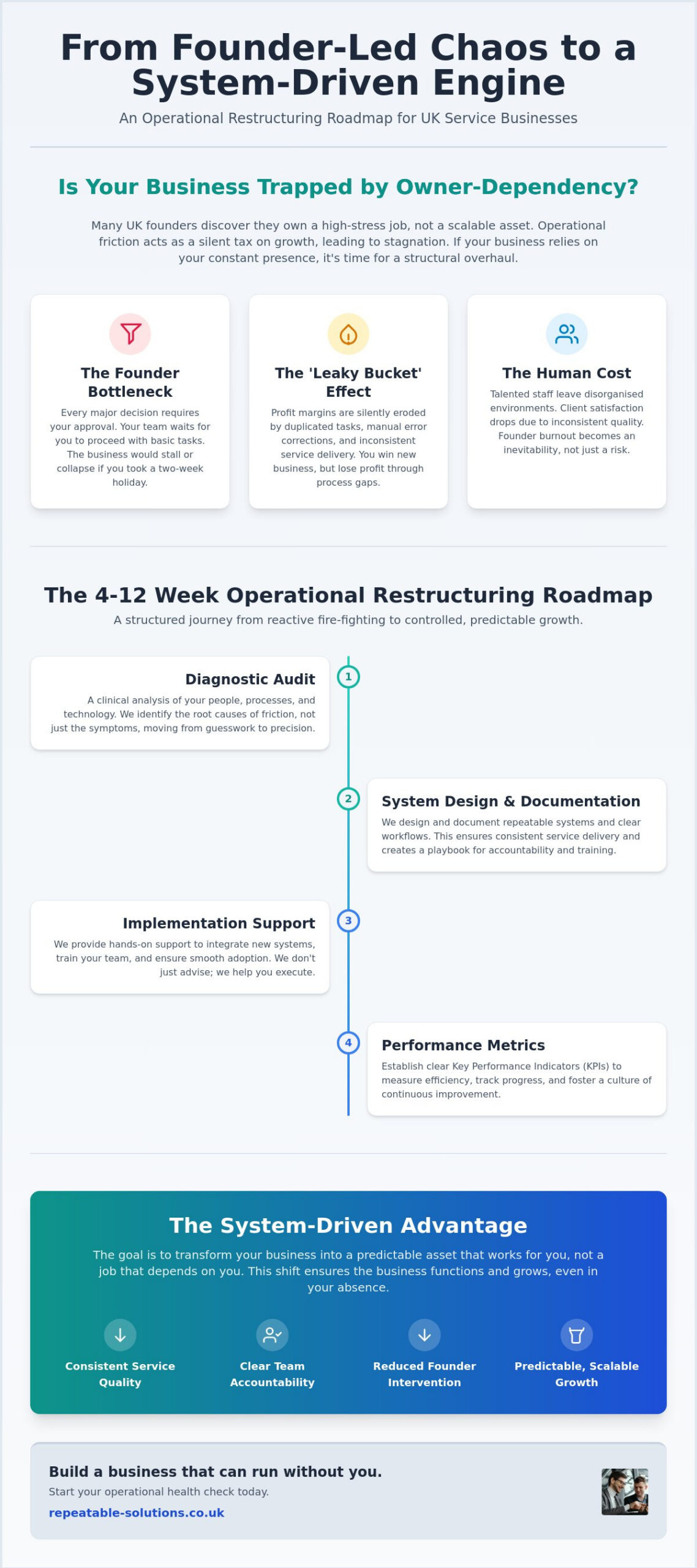
The Operational Restructuring Roadmap: From Audit to Execution
Transforming a business from owner-led chaos to a scalable engine requires a methodical sequence. It isn’t a random collection of improvements. A professional operational efficiency consultancy UK follows a structured roadmap that typically spans 4 to 12 weeks. This timeline ensures that changes are deep enough to stick but fast enough to maintain momentum. You don’t need a perpetual project; you need a defined exit from disorder.
- Diagnostic & Workflow Audit: We strip the business back to its core. We identify where time is leaked, where communication breaks down, and where the owner’s presence is a hindrance.
- Process Redesign: We build the “Repeatable System” blueprint. This replaces manual, personality-driven effort with documented, automated workflows.
- Implementation: We deploy accountability frameworks. We train the team to operate the new system without your constant input or micromanagement.
- Sustainability: We establish non-executive leadership. This provides long-term oversight and ensures the business remains aligned with its strategic goals.
The Critical First 12 Weeks
The first 90 days determine the success of any operational change. This is the period where momentum is either built or lost. You need clinical precision when diagnosing bottlenecks during this window. If the diagnostic phase is rushed, the entire restructuring will be built on a flawed foundation. Success depends on improving business workflow efficiency within a fixed term. A disciplined approach ensures that the new systems are not just theoretical but are actively reducing friction in daily operations. If you aren’t seeing measurable shifts in team independence within twelve weeks, your consultancy partner isn’t delivering execution.
Building Accountability and Performance Frameworks
Accountability is the scaffolding that holds a system-led business together. Without it, your team will naturally revert to the path of least resistance. We replace “hope” with data-driven decision making to maintain operational stability. An accountability framework defines exactly who is responsible for what, when it’s due, and how success is measured. This removes the emotion from management. It allows you to lead through metrics rather than through constant intervention. To begin this transition, you should evaluate your current operational health through a structured audit.
Building Repeatable Systems with Repeatable Solutions
Repeatable Solutions functions as the clinical “fixer” for UK service businesses. We don’t deal in vague theories or superficial improvements. Instead, we specialise in the surgical removal of founder-dependency. If your business relies on your daily presence to function, it’s a liability, not an asset. As a dedicated operational efficiency consultancy UK, we provide the structural integrity required to turn manual effort into a scalable machine. We approach every project with a direct, unsentimental focus on results. Our goal is to identify the hidden fractures in your workflow and replace them with systems that work.
We focus specifically on service-based companies with complex internal processes. These are organisations where “hustle” has reached its limit and the owner is the primary bottleneck. We act as the bridge between current operational chaos and future exit-readiness. Whether you intend to sell your business or simply want it to grow without your constant intervention, the path is the same: repeatable systems. We provide the scaffolding that allows a business to function with clinical precision, ensuring that delivery is consistent and profit margins are protected from wasted effort.
Moving from Firefighter to CEO
When systems take over, your role shifts. You move from being a reactive firefighter to a proactive leader. This transition is often difficult for founders who are used to being at the centre of every decision. To ensure this change is permanent, we provide non-executive leadership support UK. This ongoing oversight provides stability and prevents the team from slipping back into old, inefficient habits. There is a profound freedom in knowing that your revenue is no longer tied to your personal capacity. You gain the clarity to focus on high-level strategy whilst the engine runs itself in the background.
Your Next Steps to Operational Excellence
Chaos is expensive. It’s better to perform a proactive health check now than to wait for your next growth spurt to cause a total system failure. Our project-based engagements are designed for immediate, tangible impact. We enter, we diagnose, we implement, and we exit once the systems are stable and the team is accountable. This isn’t about building a long-term dependency on us; it’s about ensuring your independence from the daily grind. Don’t let your business remain a personality-driven job. Book your Operational Diagnostic with Repeatable Solutions today to start building a business that actually works.
Transitioning to a System-Led Future
Operational friction is a structural threat to your business’s long-term viability. We’ve seen how owner-dependency creates a growth ceiling that no amount of manual effort can break. By selecting an operational efficiency consultancy UK that prioritises clinical diagnostics over immediate software sales, you ensure your restructuring is built on a foundation of logic and data. A boutique partner provides the senior-level attention and agility required to fix hidden fractures in weeks rather than years.
Repeatable Solutions brings over 30 years of industry experience to every project. We specialise in service-based business restructuring through fixed-term engagements that move you from an initial audit to full sustainability. Our focus remains entirely on your eventual independence and the durability of the systems we implement. You don’t need a permanent consultant; you need a business that functions without one.
Book your 12-week operational diagnostic with Repeatable Solutions and begin the transition from firefighter to CEO. It is time to turn your business into a predictable, scalable asset.
Frequently Asked Questions
What does an operational efficiency consultancy actually do?
An operational efficiency consultancy identifies and fixes the structural fractures that cause friction in your business workflows. They move a company from manual, owner-dependent effort to a system-driven model. This involves conducting clinical audits of current processes, redesigning workflows for maximum scalability, and implementing accountability frameworks. The primary goal is to build a predictable machine that functions independently of the founder’s daily intervention.
How long does a typical operational restructuring project take?
A meaningful operational transformation usually spans between 4 and 12 weeks. The initial phase focuses on a diagnostic audit to uncover the root causes of friction and wasted effort. Following this, the redesign and implementation phases ensure that new systems are adopted by your team. This fixed timeline prevents the project from becoming an open-ended corporate engagement whilst providing enough time for structural changes to take hold.
Is my business too small for an operational efficiency consultant?
Complexity and owner-dependency are better indicators of need than headcount. If you’ve reached a growth plateau where manual effort no longer scales, you likely need an operational efficiency consultancy UK. Small service-based firms often benefit most from structural alignment before they hire more staff. Adding people to a broken system only increases chaos; fixing the system first ensures that every new hire is an asset rather than a burden.
How do you measure the ROI of operational efficiency consultancy?
ROI is measured through reclaimed founder time, improved profit margins, and reduced error rates. You should see a direct correlation between systemisation and a decrease in the owner’s involvement in low-value administrative tasks. Additionally, consistent service delivery leads to higher client retention and lower staff turnover. These tangible financial returns often far outweigh the initial investment in restructuring your internal operations.
What is the difference between business coaching and operational consultancy?
Coaching focuses on the individual’s leadership skills, whilst consultancy focuses on the business’s structural mechanics. A coach might suggest that you need to delegate more; a consultant builds the actual systems and accountability frameworks that make delegation possible. Consultancy is about building the engine and the scaffolding, ensuring the business has the structural integrity to function without the driver constantly holding it together.
Can operational efficiency be improved without buying new software?
Efficiency is a process problem, not a technology problem. Automating a broken or redundant workflow only produces “automated chaos.” Significant capacity can often be unlocked simply by removing duplicated efforts and refining communication channels. Whilst software can support a well-designed process, the priority must always be process design and structural alignment. You shouldn’t spend money on new subscriptions until your underlying workflows are lean and logical.
What happens if my team resists the new processes?
Resistance is usually a symptom of poor accountability frameworks or a lack of clarity in roles. We address this by involving the team during the diagnostic phase and providing clear implementation support. When staff see that new systems reduce their own daily stress and fire-fighting, adoption naturally follows. The focus is on building systems that are easier to follow than they are to ignore, backed by data-driven performance metrics.
How much does an operational efficiency consultant in the UK cost?
Fees are generally determined by the scope of the project and the consultant’s specific expertise. As of June 2026, the median day rate for an operations consultant in the UK is £625, compared to £540 for general consultants. It’s best to view this as a project-based investment with a defined exit point rather than a permanent overhead. The objective is to achieve long-term sustainability and owner independence through a fixed-term engagement.